29.04.2026
Equities Did It. Private Credit Did It. Now Its Fixed Income’s Turn.
Introducing Gyld’s tokenized US investment-grade corporate bonds.
Real-world assets on chain crossed $29 billion in Q1 2026, up 263% year over year. The number understates the shift. Behind it is something more important: tokenization has stopped being a thesis and started being a market.
The proof is in what is working.
Tokenized US Treasuries crossed $13 billion in March, anchored by BlackRock’s BUIDL, Franklin Templeton’s BENJI, and Ondo’s USDY. Government debt now trades as an on-chain asset class with real institutional flows.
Tokenized equities turned from experiment into product. Ondo Global Markets alone offers 100+ US stocks and ETFs. Tokenized equity TVL crossed $1 billion in March.
Tokenized private credit has matured into a working market. Roughly $5 billion of distributed value sits on chain through Maple, Goldfinch, Centrifuge, and others, with broader counts that include platform-locked assets pushing the figure closer to $19 billion.
Each of these is an asset class that has been validated in production. Real yield, real issuers, real secondary liquidity. The pattern is consistent: when the underlying market is large, liquid, and yield-generating, it ends up on chain.
That brings us to the $11 trillion question.
The largest asset class no one has tokenized yet
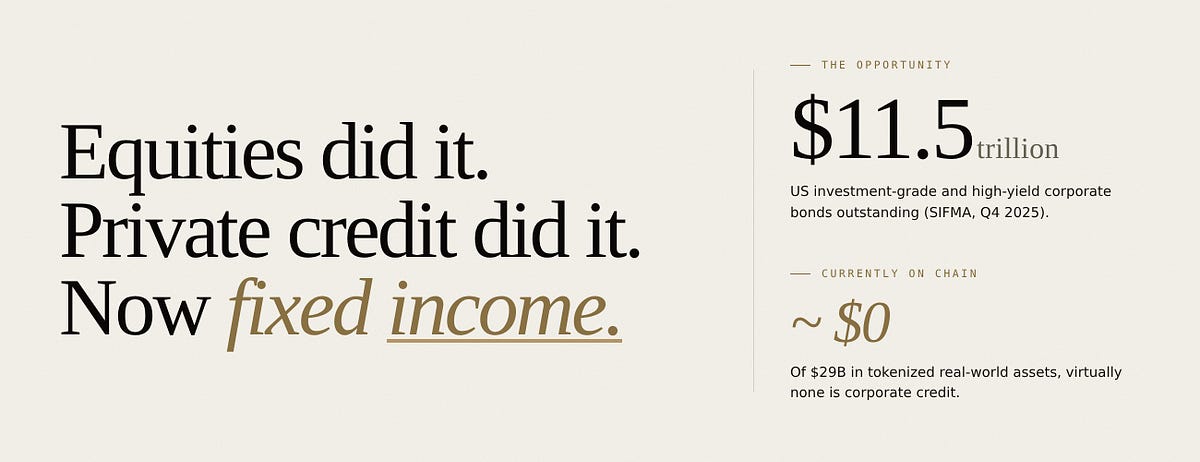
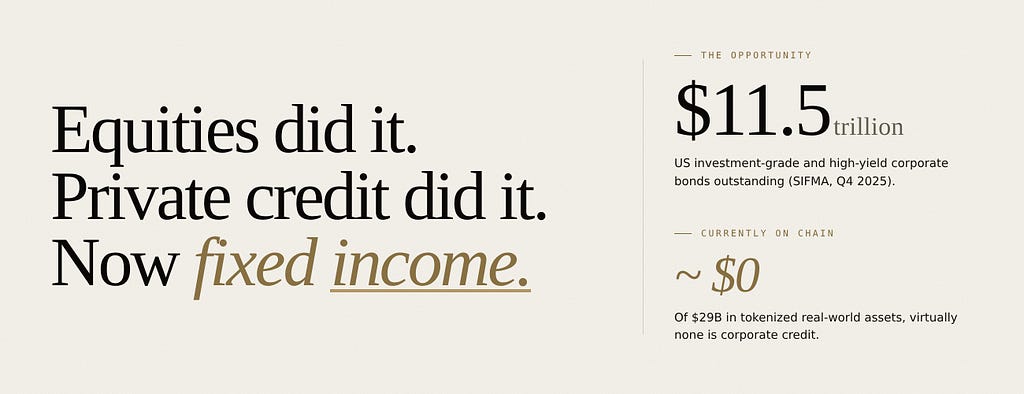
The US corporate bond market sits at $11.5 trillion outstanding (SIFMA, Q4 2025). It trades north of $70 billion a day. Investment-grade issuance alone is projected at $2.25 trillion gross in 2026. By any measure, it is the largest segment of the largest financial asset class on earth. Global fixed income outstanding is now over $145 trillion, materially larger than global equity market capitalisation.
And yet, on chain, corporate bonds are essentially absent. Tokenized Treasuries dominate the RWA category. Private credit is meaningful. Corporate bonds, the segment with the most depth, the most liquidity, and the longest institutional history, have barely begun to migrate.
Why investment-grade corporates first
Among fixed-income instruments, IG corporate bonds are the natural starting point.
They are standardized. Every IG bond shares the same structural DNA: coupon, principal, maturity, covenants, ratings. There is no ambiguity about what you own.
They are deep and liquid. IG is the most heavily traded segment of corporate credit. Daily marks are available, pricing is transparent, and the dealer-to-dealer market has decades of price discovery built in.
They are rated. Moody’s, S&P, and Fitch cover virtually every issuer. Allocators do not need to underwrite credit from scratch, they need to access it.
They have predictable cash flow. Coupons twice a year, principal at maturity. The financial primitive is simple, which makes it composable. An IG bond token is a building block that other on-chain structures can use.
They are familiar. Every institutional allocator already underwrites IG credit. Tokenization is not asking allocators to learn a new asset class, it is asking them to access one they already understand through better rails.
That last point matters most. Tokenization wins where it provides infrastructure improvements on top of an asset the market already wants. Treasuries proved this. Corporate bonds will too.
The capital is already on chain
Around $300 billion in stablecoin capital sits on chain today looking for yield. Most of it earns nothing. A subset earns Treasury yields through tokenized funds. Almost none of it has direct, native access to the credit spread between Treasuries and corporate bonds, the spread that powers the bulk of fixed-income returns in the real world.
As of March 2026, the average IG corporate yield was 5.11%, against a comparable Treasury at roughly 4.2%. That 80 to 93 basis point spread is currently inaccessible to on-chain capital without leaving the chain. The unmet demand is structural, not cyclical.
What we are launching
Gyld is launching tokenized USD investment-grade corporate bonds. High-yield will follow.
The instruments are:
- Non-US distributed, designed for international institutional allocators
- USD-denominated, paying USD yield through their underlying coupons
- Backed 1:1 by the underlying corporate bond, held in regulated custody
- Freely transferable on permissionless rails after issuance
- Composable as collateral and as a building block for structured products
- Available through crypto-native channels: exchanges, DAT treasuries, DeFi vaults
The first cohort spans high-quality issuers across financials, tech, and consumer: JPMorgan, Apple, Microsoft, Goldman Sachs, Bank of America, Nvidia, Meta, Citi, Morgan Stanley, and Pfizer, among others. These are not synthetic wrappers or basket exposures. They are the bonds themselves, on chain.
What this unlocks
A few things become possible the moment IG corporates live on chain:
- Allocators with stablecoin balance sheets can earn corporate credit yield directly, without touching legacy custody.
- Vaults and structured products can use tokenized IG bonds the way TradFi uses them: as a yield base layer, as collateral, as a defensive sleeve.
- Crypto-native treasuries, DAOs, DATs, and exchanges gain a familiar, rated, dollar-denominated reserve asset.
- Secondary liquidity can develop natively on chain, with 24/7 settlement and none of the T+1 friction of legacy clearing.
This is what fixed income on chain looks like. Not synthetic exposure. Not a wrapper. The actual bond, with the actual cash flow, on the same rails the rest of crypto already runs on.
The pattern holds
Equities went on chain. Private credit went on chain. Treasuries went on chain. In each case, the question was the same: is this asset class large enough, liquid enough, and well-understood enough to justify migration? In each case, the answer was yes, and the result was real volume.
Corporate bonds are bigger than all three combined.
This is fixed income’s moment.
Backed by Lightshift Capital. Launching Q3 2026. If you allocate on behalf of an exchange, DAT, vault, or treasury, request access.